
“With Wondering Awe” is a popular Christmas hymn, number 210 in the current LDS hymnbook. It has traditionally been ascribed to an anonymous author and composer and sourced to a Catholic hymnbook published in 1885.
.

LDS Hymns, 1985.
Here’s the source cited in the 1985 LDS hymnbook. Note that the hymnbook Laudis Corona was first published in 1880, although an 1885 edition is mentioned in the LDS hymnbook. ((See image in “Sources.”))
.

Laudis Corona, 1880.
On Saturday evening my friend Rob Fergus was researching the history of the hymns scheduled to be used the next day in his Sunday worship services. Unsatisfied with the anonymous attribution, he began searching online, and eventually found this ad in Google’s digitized copy of The Musical Times, which identifies the author as F. E. Weatherly and the composer as Wells Ingram.
.

The Musical Times, 1885.
After a little more poking around online, he found that George Wells Ingram was a musician in Birmingham and that the lyricist Frederic Weatherly was an English barrister who wrote thousands of popular lyrics, and is most famous for “Danny Boy” and “The Holy City.”
Excited about the find, and wondering if it was something notable, Rob sent me a message with the news. I saw his note and began looking around online as well. With these names we were able to find additional information, including another listing citing their authorship.
.
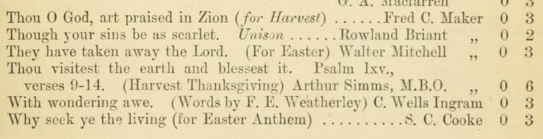
Sims Reeves: His Life and Recollections, 1888.
The lyricist, Frederic Edward Weatherly, KC (4 October 1848 Portishead, Somerset – 7 September 1929 Bath, Somerset), was the son of Frederic Weatherly and Julia Ford. A barrister and author, he was a prolific lyricist with over 3,000 works. Besides his best-known works “Danny Boy” and “The Holy City,” he also wrote a World War I favorite, “Roses of Picardy.” ((Modern listeners may be familiar with “Roses of Picardy” from its use in It’s the Great Pumpkin, Charlie Brown.)) After the deaths of his wife Minnie and his long-time companion, Maude, he remarried Maude’s nurse, Miriam Bryan. A wealthy man, he wrote an autobiography, Piano and Gown, that is unfortunately not yet available online.
The rhyme, rhythm and word usage of “With Wondering Awe” are similar to those of “The Holy City” and many other Weatherly pieces, and it seems to fit seamlessly into his body of work. If he wrote it before the death of composer Wells Ingram in 1875, it would have been an early work.
The composer, George Wells Ingram (19 July 1829 Birmingham, England – 6 January 1875 Solihull, Birmingham), was born to button manufacturer, Thomas Wells Ingram, and his wife, Ann Hughes Hodgett. He sometimes went by the name “Wells,” as his father had done. His father seems to have died when George was about 20, so he took over the button factory and later moved into the manufacture of powder flasks. When he died at age 45, he left a small legacy to his widow Augusta and young children. He was called “the finest amateur musician of his day in Birmingham,” but nothing else is known to remain of his work. ((“Mr. Alfred R. Gaul,” The Musical Herald [London], November 1889, 242. Note that George Wells Ingram’s death date was 1875, not 1877 as noted in The Musical Herald. I have checked the Birmingham public and university library catalogs but do not see anything cataloged to his name.))
We were unable to find a copy of the original sheet music online, but were able to see that the British Library has a copy.
.

LDS Adoption of the Hymn
As Karen Lynn Davidson noted in Our Latter-day Hymns, “With Wondering Awe” was first published in an LDS hymnal, the Deseret Sunday School Union Music Book, in 1884. Hymnary.org does not list another non-LDS use until 1890, so the 1880 Laudis Corona could have been the source for its use in the Deseret Sunday School Union Music Book.
.

Deseret Sunday School Union Music Book, 1884.
It was not included in the 1889 Latter-day Saints’ Psalmody, so the next time it was used in a Mormon hymnbook seems to have been in a 1908 collection published by Northern States Mission President German E. Ellsworth to “satisfy a long felt want in the Mission Field,” and it has been included in LDS hymnals ever since.
.

Songs of Zion, 1908.
Making a Final, 100% Watertight Identification
Why were the lyricist and composer not mentioned in the American sources? It may have had something to do with a long-running international battle over copyright. For a description, see the brief but well-written article, “International Copyright Act of 1891.”
There are no other hymns or carols by the name “With Wondering Awe” in online hymn databases including hymnary.org and cyberhymnal.org. ((The phrase “with wondering awe” shows up in Jennette Threlfall’s hymn “Thou biddest us to seek thee early,” but it first appeared in 1883 so she may have been quoting the Weatherly/Ingram carol.)) I have not found any other carols of this name in search engines or book databases.
Nothing exists in the great American historical sheet music collections, which would suggest that the carol went directly from an English source into the American hymnals, and was not published as sheet music in the United States.
Perhaps the only way to make a final, 100% watertight attribution would be to visit the British Library and view the copy there since it is not available through their digital ordering service. Any takers?
Sources
Adams, Stephen and Frederick E. Weatherly, “The Holy City,” [lyrics], Music in the Works of James Joyce, [website], accessed December 13, 2015.
“A Christmas Carol,” [“With Wondering Awe,”] in Festival Poems: A Collection for Christmas, the New Year, Easter. Cambridge, Massachusetts: University Press, 1884, 109.
“A Christmas Carol,” [“With Wondering Awe,”] in Deseret Sunday School Union. Deseret Sunday School Union Music Book: Containing a Large Collection of Choice Pieces for the Use of Sunday Schools. Salt Lake City: Deseret Sunday School Union, 1884, 86.
Boston University Libraries. Digital Sheet Music. [Index.] (All collections searched.)
“Christmas Carol,” [“With Wondering Awe,”] in Deseret Sunday School Songs. Salt Lake City, Utah: Deseret Sunday School Union, 1909, 101.
Davidson, Karen Lynn. Our Latter-Day Hymns: The Stories and the Messages. Salt Lake City, Utah: Deseret Book, 2009.
Frederic Weatherly: some information from English census and vital records; otherwise from Fred E. Weatherly, K.C., 1843-1929: From Glen to Glen and Frederic Weatherly.
George Wells Ingram: all sources from English census and vital records and The Musical Herald.
“Mr. Alfred R. Gaul.” The Musical Herald [London, England], November 1889, 242.
Reeves, Sims. Sims Reeves: His Life and Recollections Written By Himself. London: Simpkin Marshall & Co., 1888, [catalog, 21].
“With Wondering Awe,” [advertisement for Christmas carol by F. E. Weatherly and Wells Ingram]. The Musical Times, November 1, 1885, 693; December 1, 1885, 751.
“With Wondering Awe,” [advertisement for Christmas carol by F. E. Weatherly and Wells Ingram]. The Guardian [London, England], November 10, 1886, 1706.
“With Wondering Awe,” in Church of Jesus Christ of Latter-day Saints. The Songs of Zion: A Collection of Choice Songs, Especially Selected and Arranged for the Home and for All Meetings, Sunday Schools and Gatherings of Elders and Saints in the Mission Field. 1908, 101.
“With Wondering Awe,” in Church of Jesus Christ of Latter-day Saints. Hymnal. Salt Lake City: The Church of Jesus Christ of Latter-day Saints, 1985, 210.
“With Wondering Awe,” in Laudis Corona: The New Sunday School Hymn Book. New York: D. &. J. Sadlier, 1880, 44.
.

Laudis Corona, 1880.
“With Wondering Awe,” in Laudis Corona: The New Sunday School Hymn Book. New York: D. &. J. Sadlier, 1885 [reprint], 44.
Notes
I’ll gladly go search for the original if someone will sponsor my travel expenses!
So selfless, HokieKate! 😀
Maybe HokieKate could draw upon that Treasury of which she is the Treasurer to pay for her travel.
But, seriously, I like this post. To be honest, I had never wondered about who wrote this carol–but as soon as I saw this post I began to wonder. And then, bam! there was the answer. Thanks Amy (and Rob, if you drop by) for solving this mystery!
It kind of makes me wonder how many other Christmas carols were written by the same author and composer that never made it into the hymn books. Why is it that this one survived and others did not? Was it just the personal preference of one person who compiled a hymnbook that preserved that particular carol and are there other hymns that perhaps would be more popular today but were never preserved? Something to think about.
On a slightly related note, I wonder how popular this carol is today and if the hymnbook were revised would this one survive the cut. It might, but it makes you think about the fate of those that don’t.
The treasurer says the rest of y’all need to chip in and support Keepa’s server fees.
Thanks, Mark B., but this was all Rob’s discovery! I just had the privilege of doing a bit of additional background research and write-up.
I agree with HokieKate in #5, and perhaps if someone in Keepa’s readership knows someone in London who could get a copy of the carol, we could solve this mystery once and for all.
Thanks for the writeup Amy. And quantumleap42, I’d like to think that any hymn that refers to the Lord as “the wondrous little Stranger” would be safe in our hymnbook for time and all eternity!
Wonderful write-up!
What a fantastic investigation! Thank you, Amy and Rob.
Outstanding.
‘Danny Boy’ was my mother’s favorite song and,of course, ‘The Holy City’ has been an Easter tradition in every ward I’ve attended for over sixty years. It’s nice to know ‘With Wondering Awe’ is from the same illustrious heritage.
And it’s little stories like this one that keep me hooked on history. What a delightful tidbit!
Excellent. I love to see it when investigations like this bear fruit.
Unfortunately, this is just one of several hymns in our hymnals that are anonymous.
I can offer one suggestion. Last I checked the British Library will scan materials on request for a fee. If there aren’t any Keepaninnies in London who could pay a visit to the library, this may be the best option.
Wonderful article!
My cousin is studying in Oxford and loves a little bit of adventure and mystery (as well as music), so I will ask him if he could find time to look it up. He’s stateside for Christmas, so it would have to wait if he were to do it.
This was fascinating, a real lesson in teasing out the details of a story, and the importance of provenance. Without seeing the original, Amy T, you are unwilling to give it as a definitive source.
Also, you got intrigued me with the James Joyce reference. I haven’t read Joyce since college, and this makes me want to revisit Ulysses and reread the chapter where “The Holy City” is mentioned.
Very cool–in times past, I’ve dug into some other hymns with no or shaky authorship so this was very interesting to see.
It’s so very interesting to have these minor mysteries solved! (At least as solved as they can be without a trip to the British Library…) Learning the stories behind the hymns makes them more meaningful to me when we sing them during meetings on Sundays.
Nice job!
We don’t have that song in our hymn book (I wonder why the foreign language hymnals are usually quite a lot thinner than the English one). I had to check this out in youtube, a lovely song.
I’ve asked a musican friend to read the post as soon as she is able to access it. She will be in London in April and will look it up then, if the mystery hasn’t already been solved.
Wonderful, Laura. Thank you!
“I wonder why the foreign language hymnals are usually quite a lot thinner than the English one”
Niklas, translation is both difficult and expensive, as you no doubt know. I suspect that the Church doesn’t see a need to translate the complete hymnal, so it doesn’t. It also isn’t all that great at acquiring translations from local members and others (although I think that is beginning to change).
IMO, the ideal response is for local members to take on the challenge and translate missing hymns. Its not easy, but I think there are great benefits for the Mormon community.
Kent, yes translation is expensive. I mostly wonder that because in the old version of our hymnal there were many songs that are not in the newest one. They could at least have include all the songs that were already translated. But it seems that they wished to limit the number of the hymns to exactly 200.
Odd, Niklas. That may be a cost issue — trying to keep the cost of each copy to a target price or something. I don’t know. I wish I knew more about their reasoning.
I’d be interested in discussing this more with you — depending on the language, there may be a way around this. Would you be willing to email me? kent [dot] s [dot] larsen [at] gmail [dot] com
Most countries with a long Christian tradition have produced many great hymns of their own, which might flesh out a translated hymnal. Some hymns like “The Spirit of God” have enough Mormon historical resonance that they really need to be translated for every Mormon to sing. But the church is no less true if we sing different hymns in different languages. I know hymnals in various languages have some different hymns, but it’s puzzling that we don’t bring more hymns that don’t have to be translated in, if the hymnals are very thin.
Carols in the German hymnbook but not in the English:
* Es ist ein Ros entsprungen (Lo, how a Rose e’er blooming)
* Tochter Zion, freue dich
* O du fröhliche
* Lobt Gott, ihr Christen, all zugliech (performance in the link from from a Relief Society Choir in Heidelberg)
That’s four. They probably would have had a revolution if they’d left out the first and third of those! “With Wondering Awe” is there, translated as “Mit Staunen sahn die Weisen nahn.”
There are 210 songs in the current German hymnbook, 240 in the previous one. We had a contest here a couple of years ago to come up with some extra verses for “Hark, All Ye Nations” from the original German. It was difficult! Translation takes one level of skill; translating lyrics takes literary talent as well.
Four?! And only Advent or Christmas hymns at that? It’s not like Germany ever had any church musicians of note… Actually, I’d bet you could probably put together a respectable collection of hymns just from German musicians named Johann. Some of the old texts might not be in full harmony with LDS doctrine, but we change words and skip verses all the time. There’s a bunch of Isaac Watts texts in English — if only someone like Martin Luther had written a lot of hymn texts in German…. And there are, of course, no modern German poets or musicians who might make a valuable contribution to LDS hymnody….
I know, it’d be a lot of trouble to put together a good hymnal for every language, from hymns people who speak those languages might already know. But why should English speakers have all the fun?
Even better, if we has such hymnals, Mike R., no doubt more hymns would be translated into English (and into other languages as well).
Think of how our worship would be enriched!
I see now that Amy T. listed the 4 “carols” that are in the German hymnal but not in the English one — so hopefully there are more than 4 such hymns total. Still, with only 210 hymns in the book, there is room for many, many more.
I’m not familiar with the German hymnal, but usually there aren’t too many national hymns in the book.
I realize I am a few years late to this discussion, but I only discovered this blog post a couple weeks ago. After contacting the British Library to verify if the first line was the same as the hymn in the Latter-day Saint hymnal (and it was), I ordered a copy of the sheet music, and now can state with certainty that the music is completely different than the tune found in the LDS hymnal. More importantly, even though Weatherly is listed as author of the words in the advertisements for this song, on the sheet music itself is the following note: “The words from the “Children’s Illustrated Birthday Book” edited by F. E. Weatherly.” Weatherly borrowed these words from the children’s magazine St. Nicholas (December 1877).
The only other source I have found listing author and composer names credits the words to L. V. Blake, and the music to William K. Bassford (who incidentally also composed the music to “Can a little child like me” in the current children’s song book). For more information, see my blog post concerning “With Wondering Awe” here: https://ldshymnology.wordpress.com/2018/12/23/with-wondering-awe/